What Once Was Wet Is Now Dried Up When Once Again the Water Flows
Make Water Disappear—with the Wet-Sand Effect
A beachy scientific discipline action from Science Buddies
Primal Concepts
Physics
Materials
Compression
Geology
Introduction
Summer is a squeamish time to take a stroll at the beach and walk barefoot forth the shoreline. While doing that, accept you ever looked at your footprints in the wet sand? If and so, you might take noticed that with every stride it looks like the sand around your feet dries out. Why is that? These dry footprints are caused by the pressure of your feet. Y'all will detect out exactly how this happens past trying this beachy action!
Groundwork
Many beaches are made of sand, which comes from—rocks that accept been ground into tiny particles past water and wind. Materials such as sand that are made of many split tiny particles are chosen granular materials. Even when sand particles appear to be directly touching each other, because they are irregularly shaped, there are tiny spaces in between them. (Think about how a pile of larger rocks has like spaces between them.) These spaces are called pores. There are many pores between all the sand particles at the beach.
If y'all pour h2o on the sand, the h2o seems to disappear into the sand. It doesn't actually disappear—it drains into the tiny pores betwixt the grains. Once all these pores are filled with water, the sand is saturated, which means that the sand cannot accept up any more water. When you squeeze this saturated sand, y'all would probably look the water in the sand to come out of the pores over again, similar to what happens when you squeeze a wet sponge. However, this is not what happens. The exact opposite is the instance. More water seems to disappear into the sand! The reason for this is something called dilatancy of granular materials.
Dilatancy means that a material expands when you squeeze it (put it under pressure level) instead of contracting. This happens because under pressure level the sand grains actually push each other slightly further apart, which makes more space betwixt them. This means in that location is more space for water to menstruum into, resulting in a dry out footprint on the beach. Once the pressure is released, the sand grains settle closer together once more, leaving less room for water. In this activity you will demonstrate this wet-sand event—and you don't fifty-fifty have to be at the beach!
Materials
- Bowl
- Sand
- Water bottle (narrow oral cavity)
- Two large balloons (ideally they will be transparent)
- Two transparent straws
- Two condom bands
- Paper
- Spoon
- Water
- Towel
- Workspace that can tolerate spills
- Broad-mouthed plastic h2o bottle (optional)
- Ruler (optional)
- Record (optional)
- Permanent mark (optional)
- C-clamp (optional)
- Ii pieces of scrap woods (optional)
Preparation
- Use the piece of paper to make a funnel, and place the funnel into the rima oris of the narrow-oral cavity water canteen. So spoon the sand into the paper funnel, filling the water bottle all the way upward with dry sand.
- Inflate ane of the balloons. Then stretch the balloon'south neck over the mouth of the h2o bottle. Flip the bottle upside-down, and pour the sand into the balloon.
- Once all the sand is in the balloon remove the balloon from the bottle, and permit the remaining air out. The balloon should now be filled with sand only.
- Add water to the sand inside the balloon until the sand is saturated and cannot absorb whatsoever more than h2o. (You can use the same inverted bottle technique that y'all used for the sand.) The sand inside the balloon should look darker from all sides once information technology is saturated with h2o. Where does the h2o go when you cascade it on the sand?
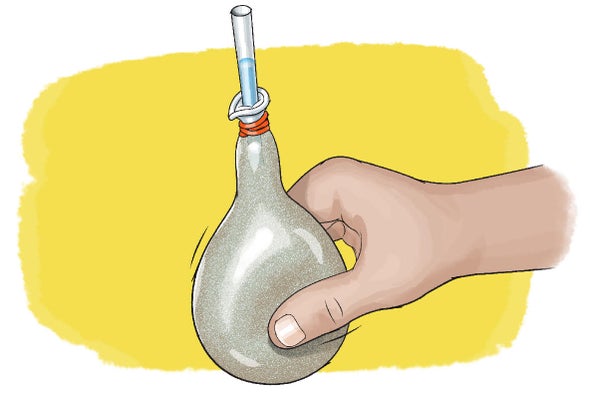
- When the sand is saturated, insert a straw far enough into the neck of the balloon and so that the end of the straw is in the wet sand. Adhere the straw tightly in identify with a rubber ring around the neck of the balloon.
- Fill the 2d balloon with water. And then insert the second straw into the neck of the airship then that the end of the straw is in the water. Again attach the straw tightly with a rubber ring.
Procedure
- Hold the balloon filled with water at its cervix where it is connected to the straw. Hold it over the bowl in instance it spills. Then add together h2o to the harbinger until it is filled one-half way. What practice you remember will happen to the water in the straw when you squeeze the balloon?
- Squeeze the balloon slightly with your easily. Observe the water within the straw. What happens to the h2o inside the harbinger? Did y'all expect this to happen?
- Put the water-filled balloon aside and pick up the sand-filled balloon. Again add together water to the straw until it is filled upwardly one-half way. What practise you expect to happen this time when yous squeeze the balloon?
- Clasp the balloon with both easily as much as you tin can. Notice what happens to the water inside the straw while yous compress the saturated sand. Does the water level in the straw rise, fall or stay the aforementioned? Can you lot explain your observations?
- Now release the force per unit area on the airship and milkshake it slightly while observing the water level in the straw. Does the water level modify again? How?
- Extra: Endeavour a simpler version of this activity. Add sand to a wide-mouthed plastic water bottle until it is iii quarters full. Add h2o until the sand is saturated and you have about a quarter inch of water standing on peak of the sand. Then squeeze the water canteen with your easily. What do you notice? While squeezing turn the water canteen upside down over a basin. Do you see water dripping into the bowl when inverting the bottle? Then stop squeezing the bottle and shake it slightly. What happens? Now turn the water bottle upside down without squeezing it. Does water get into the bowl this time?
- Extra: What other granular materials tin yous use to demonstrate the wet sand issue? Try clay, drinking glass stones or "magic sand." Do you go like results?
- Extra: Try to quantify how much water disappears into the sand depending on the pressure level you employ to the balloon. Hold a ruler next to the straw and make marks every quarter inch with a permanent marker. Then instead of using your hands to apply pressure to the airship, employ a C-clamp that you wrap effectually the middle of the balloon. To apply pressure to a larger area of the balloon, you lot can put a fleck wood pieces on each side of the balloon before you attach the C-clamp. Write down how much the water level changes with every turn of the C-clamp screw.
Observations and Results
When you squeezed the water-filled balloon you probably saw water ascension upwardly the straw every bit you expected. When y'all squeezed the sand-filled airship, yet, the water level probably went downward, which seems counterintuitive. This happens because under pressure the sand particles pushed each other farther autonomously, making the sand expand in volume. This creates more than pore infinite between the sand particles, which the water inside the straw tin drain into.
When you release the pressure level on the sand and shake the airship a trivial chip, the sand particles become back into their previous, denser arrangement. As a effect the water inside the harbinger starts to slowly rise once again as the pore space between the sand particles decreases. This is exactly what happens when you brand a dry footprint on wet sand. As your foot applies pressure to the saturated sand underneath, the grains of sand move which creates more than pore space for the water to disappear in. The sand around your human foot appears dry. When you remove your human foot—and the pressure on the sand—the water comes back out of the sand.
Cleanup
Remove the water from the water-filled airship and dispose both balloons, including the straws, in your regular trash.
More than to Explore
Dilatant Sand, from Universities Infinite Research Association
Beach Bum Scientific discipline: Compression of Wet Sand, from Science Buddies
All Mixed Up? Notice the Brazil Nut Effect, from Scientific American
STEM Activities for Kids, from Science Buddies
This activity brought to you in partnership with Science Buddies

stonehouseuntler69.blogspot.com
Source: https://www.scientificamerican.com/article/make-water-disappear-with-the-wet-sand-effect/
0 Response to "What Once Was Wet Is Now Dried Up When Once Again the Water Flows"
Post a Comment