Can You Enter the Military With a Nsfw Art Accounts
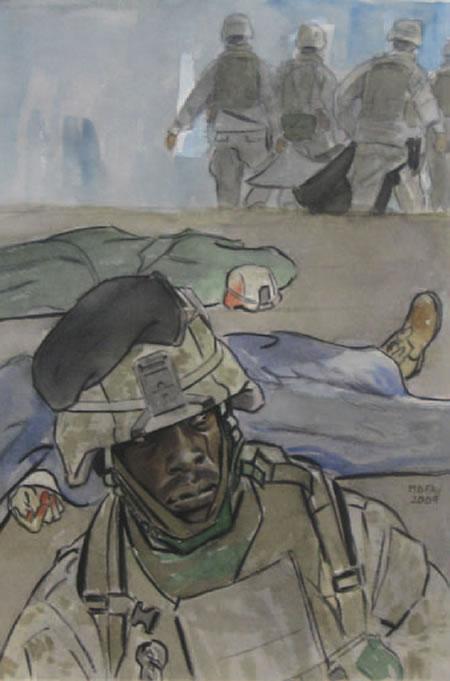
Fay'south painting of Lance Corporal Fuller, who is mourning the loss of his comrades from Operation Steel Curtain, Ubaydi, Iraq. Courtesy of the Art Drove, National Museum of the Marine Corps, Triangle, Virginia
"At starting time glance, the arts and the military might seem to take very little in mutual. But in truth, the two disciplines have a long history together. From the Greek playwright Aeschylus who took the aboriginal Farsi-Greek wars as his subject circa 472 BC, to Walt Whitman who not only wrote expansively about the U.South. Civil State of war but served as a wartime nurse, to the numerous military machine scenes captured in the visual arts, such equally August Saint-Gauden's Civil War memorial sculpture of Robert Gould Shaw and the all-black 54th Regiment, there has e'er been an overlap betwixt disharmonize and creativity.
Today, however, the relationship between artist and service member goes much deeper. For one thing, all of the military contain creative person occupations—from members of military bands to graphic artists to writers to photographers. The arts have as well become part of the protocol of armed forces wellness care as wellness professionals integrate various disciplines—music, visual arts, creative writing—into the ongoing care of troops recovering from a range of physical and mental injuries."
The paragraphs in a higher place announced in the intro to the 2012 NEA Arts magazine issue, The Soul of America, which looked at the various ways that the arts intersect with military service. Since so, the National Endowment for the Arts has expanded its back up for arts therapy as a crucial function of military wellness intendance through the Creative Forces: NEA Military Healing Arts Network and nosotros've as well recently celebrated the 10th ceremony of Bluish Star Museums, a collaboration with Blue Star Families, the Section of Defense, and more than 2,000 museums beyond the U.S. that offers complimentary admission to service members and their families each summer. The Arts Endowment likewise continues to offering grant back up to numerous nonprofits beyond the country that expressly serve veterans and active-duty personnel through arts programs. Here's a brief look at just a few of the artistic partnerships between the arts and the military that nosotros've helped to foster. We encourage yous to browse the Art Works weblog and visit the Art Works podcast library for even more stories of these types of fruitful collaborations.
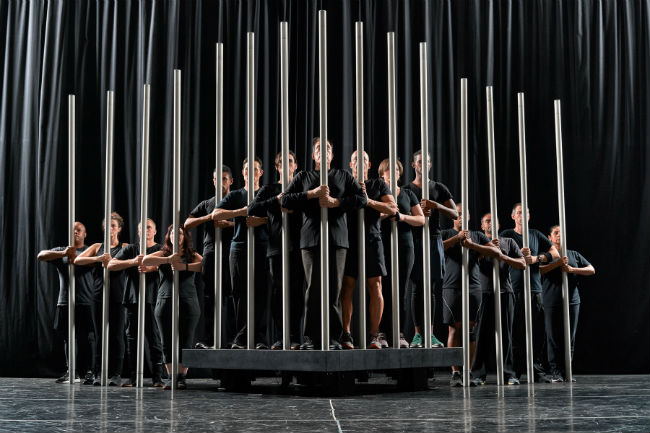
Veterans and civilians perform in A Long Journey Domicile, a production created for DIAVOLO | Architecture in Motility's Veterans Project. Photo by George Simian
Moving Veterans Toward a Identify of Healing
As the founder and creative manager of the Los Angeles-based DIAVOLO | Architecture in Motion, Jacques Heim is frequently on tour, making airdrome encounters with military personnel and veterans a common occurrence. "I don't simply say, 'I thank you lot for your service,'" Heim said of these encounters. "The question I ask them is, first of all, 'How are yous doing? Practice you need anything? How can I help you lot?' And I starting time to have this chat."
In 2015, Heim made this chat a primal part of DIAVOLO'south mission when he launched the company's Veterans Project. Through the project, expanse veterans are invited to participate in monthly motility workshops, where they move alongside civilian dancers including DIAVOLO company members. The goal, said Heim, is ultimately "restoration": restoration of conviction, restoration of strength, and restoration of who veterans might accept been physically, mentally, and emotionally before experiencing the trauma of war. Workshops culminate in public performances and Q and A sessions, which have been held at venues such equally the Kennedy Center in Washington, DC, and the American Legion Postal service 43 in Hollywood. MORE
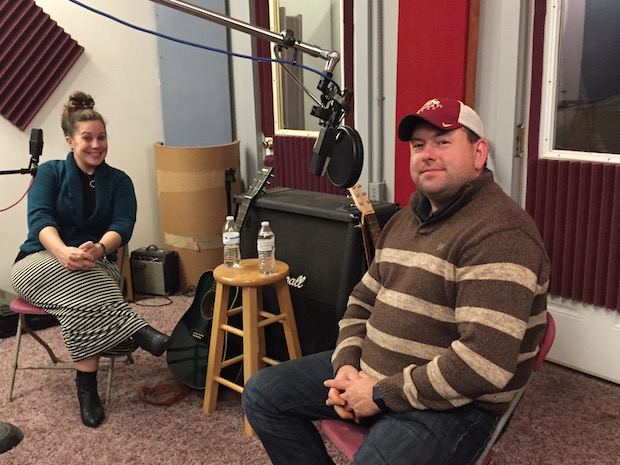
Music therapist Rebecca Vaudreuil and Michael Schneider, a retired Marine Corps Master Sergeant. Photograph by Bill O'Brien.
Music Saved My Life: How Arts Therapy Helped a Master Sergeant Recover from the Wounds of War
Two years ago Creative Forces Music Therapist Rebecca Vaudreuil met Main Sergeant Michael Schneider at Walter Reed Medical Middle. Newly retired from military service, Schneider was still in treatment for injuries he had suffered during deployment, including traumatic brain injury and PTSD. In this conversation between Schneider and Vaudreuil, he shares how engaging in music therapy allowed him to finally "featherbed injuries," and how he came to sympathise the true purpose of his healing: "… to put me back into order to assistance everybody around me, and to be a improve person for my family." More
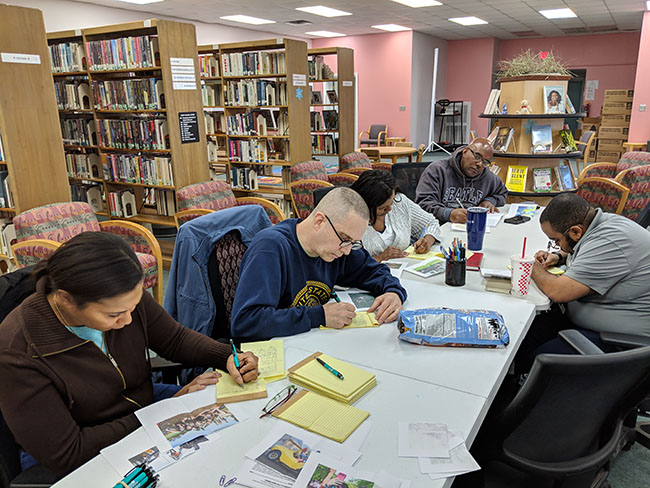
Men and women with military backgrounds participate in a Write Where You Are event at the Fort Story Library in Virginia. Write Where You Are is The Muse Writers Center'due south free program for older adults living in healthcare facilities, at-adventure youth, and service members and veterans. Photo courtesy of The Muse Writers Center
How a Norfolk Writing Center is Helping Members of the Military Notice Their Muse
Home to Navy, Air Force, Army, Marine Corps, and Coast Guard facilities, Virginia's Hampton Roads area boasts one of the largest armed forces communities in the nation. This was evident at The Muse Writers Center in Norfolk, where Executive Director Michael Khandelwal estimates that at least a third of the center's students come up from military backgrounds. Some are active duty service members or veterans, while others are married to a service fellow member or were raised past someone in the armed forces. "This is who our customs is," said Khandelwal. "Nosotros needed to be responsive to that."
And responsive they have been. With support from the National Endowment for the Arts, The Muse has created a new military component of its Write Where Yous Are initiative, which as well holds gratis workshops for older adults living in senior facilities and at-risk youth. Write Where You Are invites service members and veterans to participate in 1-24-hour interval writing seminars and half dozen-week workshops, the latter of which culminate in public readings where participants tin share their work. All activities are free-of-accuse, and are offered at the writing center itself, equally well as at military installations to aid eliminate barriers to participation. MORE
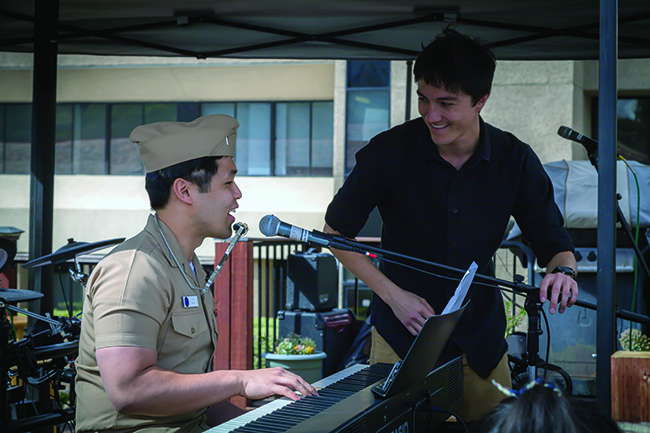
Lieutenant Jordan Lo (left) with music therapist Cory Woodrow at the second Pop-Upwards Customs Creative Arts Café. Photo by Angelito Bautista
Options for Healing: A Look at Creative Forces' Community Connections Projects
When retired Navy corpsman Jason Danley finished his tours of Republic of iraq and Afghanistan, "It was really hard to discover where I fit because it was almost like I didn't chronicle to everyone anymore," he remembered. "It made it very, very isolating. I just kind of combusted into myself." Diagnosed with mail-traumatic stress disorder (PTSD) and traumatic brain injury (TBI), he participated in music therapy equally part of his treatment at Naval Medical Centre San Diego, which not only helped him begin to process his painful experiences and rebuild his relationships, but revived a honey of music that had become buried beneath the demands of military service, fatherhood, and marriage.
Like near medical appointments, his therapy slots were held during working 9-5 hours. "But what happens from five to midnight when people are left to sit with what they're dealing with?" asked his wife Christina, who also served as a Navy corpsman. "That'south where I recall a lot of people fall apart. It opens these avenues for non practiced habits." The consequences of those habits can be devastating: more than than xx per centum of veterans with PTSD have been diagnosed with substance abuse disorder, and both PTSD and TBI are considered major hazard factors for suicide, which kills an estimated 20 veterans every day. MORE
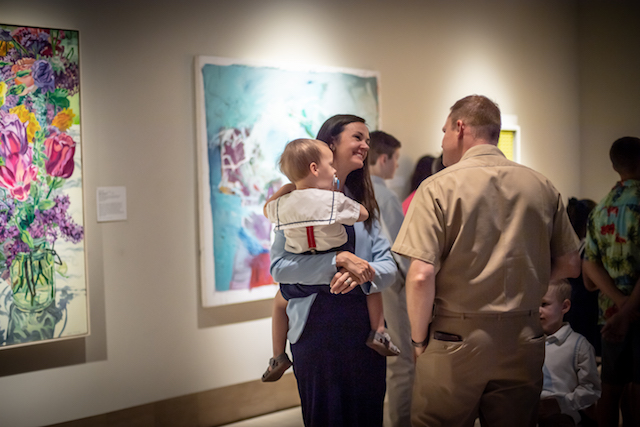
Rachel Snyder holds her son Jude while speaking with her husband Lieutenant Commander Joe Snyder at the Stein Gallery of the Cummer Museum of Fine art and Gardens in Jacksonville, Florida, during an event celebrating Blue Star Museums. Photo past Debra Heuskin.
How Blueish Star Museums is Making A Difference: One Military Family's Story
In the Cummer Museum of Art & Gardens in Jacksonville, Florida, Rachel Snyder and her children wander around the Stein Gallery taking in the artwork. She and her family have been hither before, but this fourth dimension they are helping to celebrate the 10th summertime of the National Endowment for the Arts' Blue Star Museums national initiative. Rachel's married man, Lieutenant Commander Joe Snyder, currently stationed at Naval Air Station Jacksonville, has come up to the museum event, as well. Equally an active-duty armed forces family, the Snyders are very familiar with irresolute stations, having moved 5 times since 2005. They are also familiar with Blue Star Museums, having visited the Chrysler Museum when they lived in Norfolk, Virginia, and the Saint Augustine Lighthouse in Jacksonville. With a move next yr to Whidbey Island, Washington, Rachel Snyder has already scouted out the Blue Star Museums in Seattle. We spoke with her nigh how the program has fit into and impacted her family. More
stonehouseuntler69.blogspot.com
Source: https://www.arts.gov/stories/blog/2019/arts-and-military-creative-partnership
0 Response to "Can You Enter the Military With a Nsfw Art Accounts"
Post a Comment